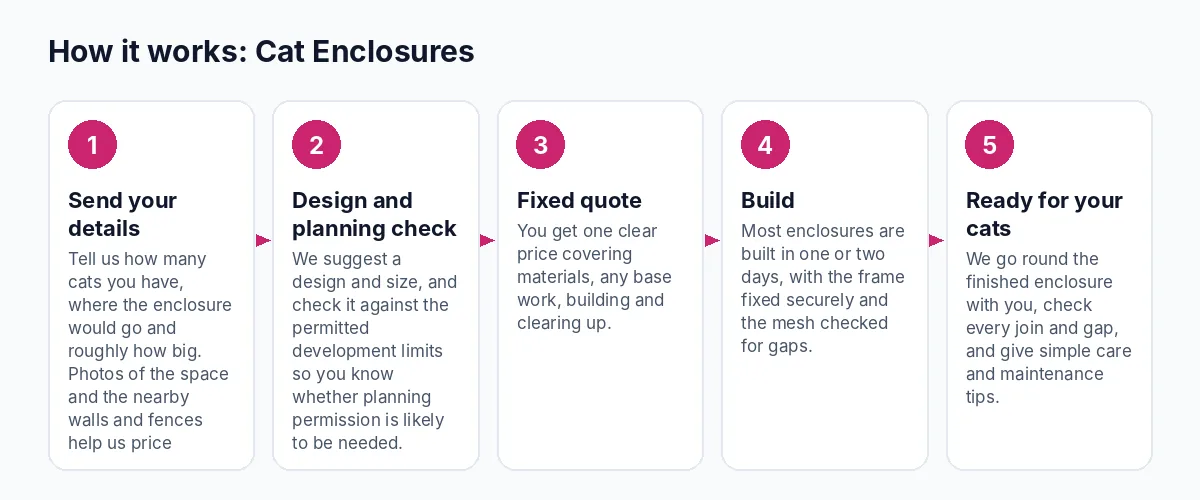
The big advantage of a house-linked catio is choice. Instead of you carrying your cat out and back, the cat decides when to go out and when to come in, which reduces boredom, scratching at doors and stress in multi-cat homes. The link might be a microchip cat flap fitted through a back door, a glass panel, a wall or a window, or a short mesh tunnel running from a window to a catio further down the garden.
Building against a house needs more care than a freestanding enclosure. The frame has to be fixed securely to the wall with suitable fixings, the roof must shed rainwater away from the house, and nothing should bridge the damp-proof course or block air bricks. If the catio covers a ground floor window, think about light and ventilation in that room. Where a cat flap goes through glass, a glazier usually needs to supply a new pane with the hole cut.
What is included
- Survey of the wall, damp-proof course, air bricks, drains and windows
- Frame fixed to the house with suitable wall fixings and a ledger board
- Roof falling away from the house with guttering where needed
- Cat flap fitted through a door, wall or window, or a link tunnel
- Welded wire mesh fixed under battens on all open sides
- Lockable door for cleaning and access
- Shelves or a ramp up to and down from the cat flap
- Escape check of the wall junction, roof edge and flap surround
Who it is for
- Indoor cats that want to come and go without needing a person to open a door
- Multi-cat homes where giving each cat more space and choice reduces tension
- Owners who are out at work and want their cats to have outdoor access all day
- Homes with a back door, patio or low window next to a usable outdoor space
- Homeowners, or tenants and leaseholders who have written consent to fix to the building
How much does it cost?
As a guide, a house-linked catio in the UK typically costs £1,800 to £4,000 or more, with extra costs where a glazier is needed to fit a cat flap in glass or a wall needs core drilling. See our full cost guide.